主讲人介绍:
Dorian Q Fuller(傅稻镰),美国籍,世界著名植物考古学专家,英国伦敦大学学院考古学院教授、中国遗产与考古学国际中心(英国)主任,陕西省千人计划特聘专家、西北大学文化遗产学院特聘教授,北京大学考古文博学院客座教授,山东省文物考古研究院特聘研究员,浙江省文物考古研究所特聘研究员。
讲座概要:
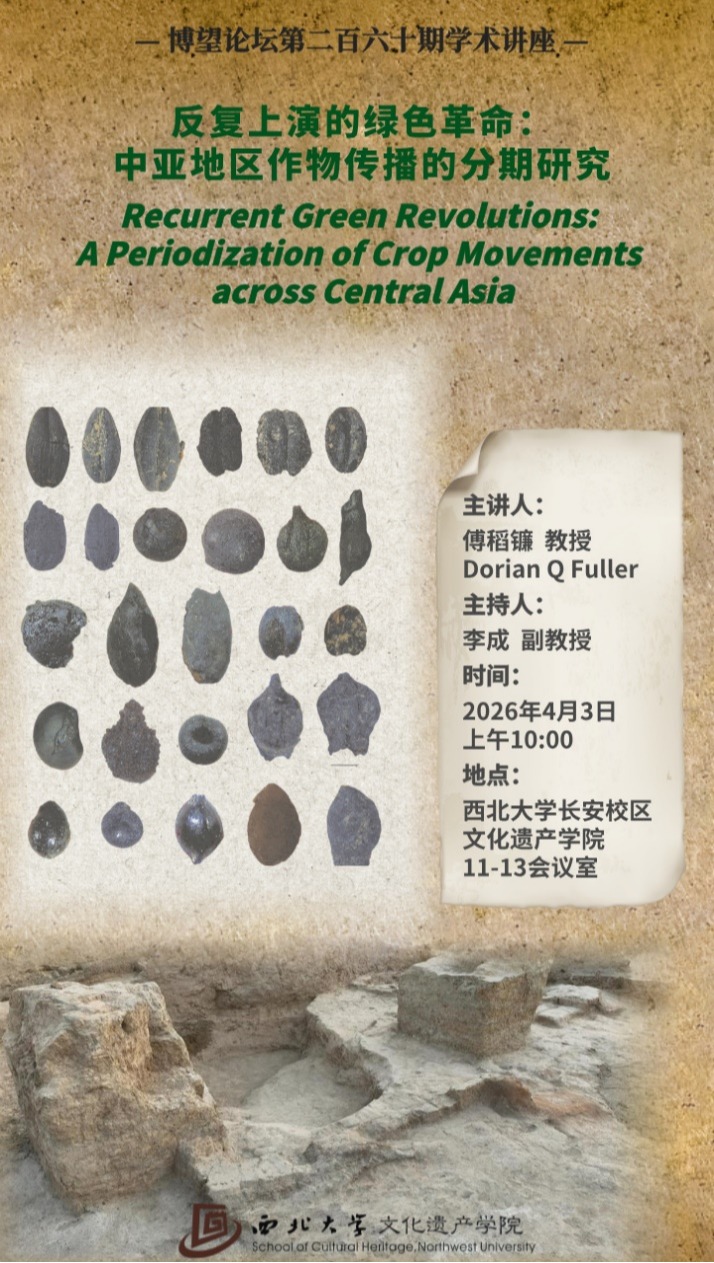
Central Asia lies between active centres of early crop domestication in Western Asia, China, and the Indian Subcontinent. It presents climatic challenges in terms of areas of low rainfall and cold winters, but nevertheless over the long term developed a high level of agricultural diversity by drawing on adoption and adaptation of a number of crops from a number of regions and through landscape modification through irrigation. “Green revolutions” have often been discussed in terms of 20th century breeding of high yield crops and low diversity agriculture or among historians of the Middle Age in terms of an “Islamic green revolution” that brought much new crop diversity to Central Asia and across the Islamic world from the South Asia to the western Mediterranean. In this lecture we will trace three earlier periods of agricultural revolution in Central Asia, from the establishment of cereal agriculture between 5000 and 4000 BP, the first efforts of diversification that included perennial vines like grape and more field crops in the late Bronze age (~3000 BP), and Iron Age broadening that included the first true cash crops (~2200-1500 BP). The “Islamic green revolution” represents a fourth agricultural transformation (1400-1000 BP). Each of these transitions involved diversification in agriculture, increasing investment in irrigation and increasing trade.
中亚地处西亚、中国和印度次大陆几大早期作物驯化活跃中心之间。尽管该地区因降雨稀少、冬季寒冷而面临气候挑战,但通过引进并改良来自多个地区的多种作物,以及借助灌溉改造地貌,中亚在长期发展中形成了高度丰富的农业多样性。“绿色革命”一词常被用于指代20世纪高产作物的培育及低多样性农业,或被中世纪史学家用来描述“伊斯兰绿色革命”——这场革命为中亚乃至从南亚到西地中海的整个伊斯兰世界带来了丰富的新作物。本次讲座将追溯中亚农业革命的三个早期阶段:从距今约5000至4000年间谷物农业的建立;青铜时代晚期(距今约3000年)首次尝试作物多元化(包括葡萄等多年生藤本植物及更多大田作物的种植);铁器时代(距今约2200-1500年)的农业扩展,出现了首批真正的经济作物。“伊斯兰绿色革命”则标志着第四次农业转型(距今1400-1000年)。这些转型均伴随着农业多样化、灌溉投资增加以及贸易的扩大。



 学院微信平台